
“On the farms of STONEFARMS, agriculture is not only about yields, hectares or profits; it is about sustainable life.”
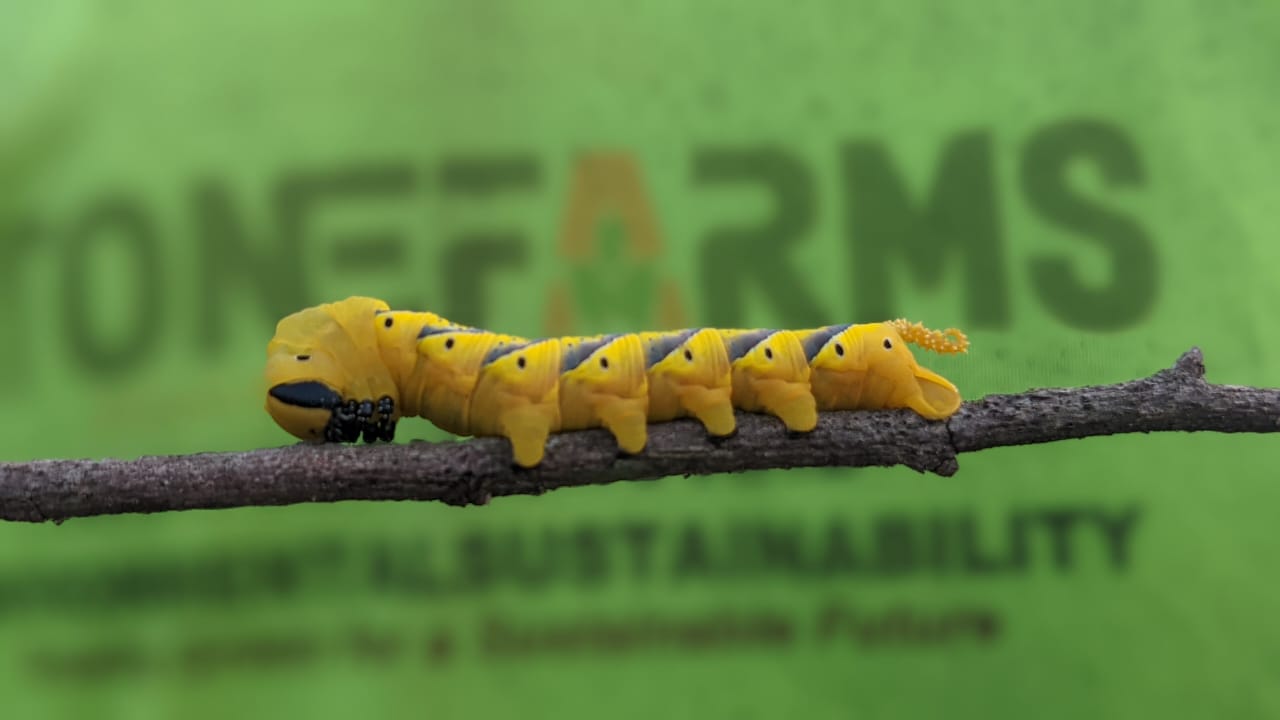
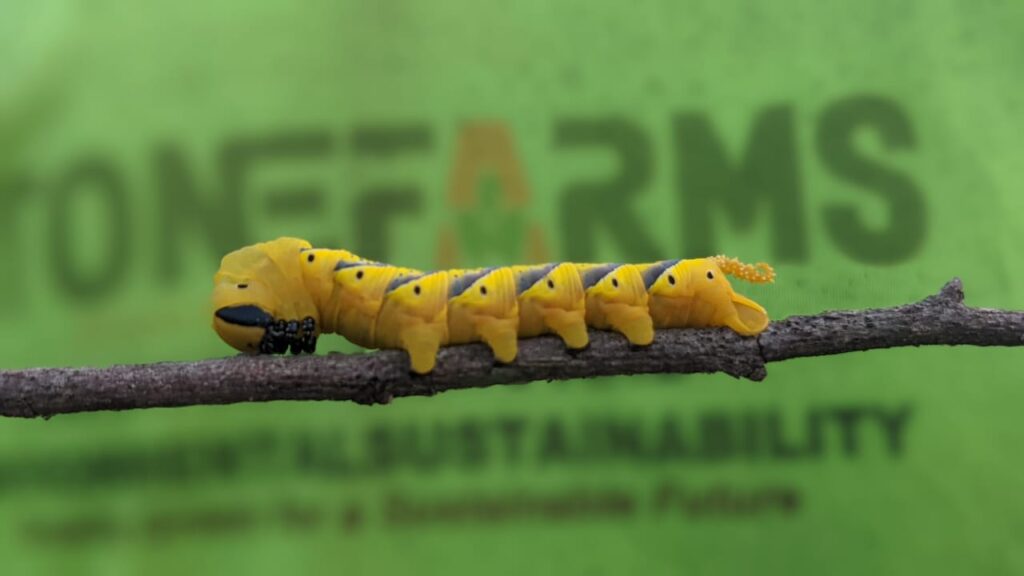
Every organism present on our land tells a story about the health of the ecosystem we manage. Recently, our team observed the African Death’s-head Hawkmoth caterpillar (Acherontia atropos) within our farming landscape. This discovery is far more than a curiosity. It is a biological signal, a message from nature confirming that our agroecological practices are fostering balance, resilience, and biodiversity.
This article explores the ecological significance of Acherontia atropos, and highlights why its presence matters for sustainable agriculture in Cameroon, Africa and beyond.
Understanding Acherontia atropos:
Beyond Myths and Fear the African Death’s-head Hawkmoth is one of the most recognizable moth species in the world, named for the skull-like marking on the thorax of the adult moth. Unfortunately, this striking feature has historically fueled superstition, fear, and misunderstanding.
In reality, Acherontia atropos is not a symbol of death, but rather a symbol of transformation, ecological continuity, and environmental health. The caterpillar stage large, colorful, and highly visible is a critical phase in the species’ life cycle. During this stage, the caterpillar feeds, grows, and accumulates the energy required for metamorphosis, eventually transforming into a strong nocturnal pollinator.
Ecological Role of the Death’s-head Hawkmoth Caterpillar
- A Key Link in the Food Web
– The caterpillar serves as an essential food source for birds, reptiles, and other insectivores. Its presence supports trophic balance, ensuring energy transfer across ecosystem levels.
– The caterpillar forms a key link in the food web, supporting birds, reptiles, and other insectivores. As an adult, the moth contributes to pollination, especially of night- blooming plants. The species is also a bio-indicator, thriving only in environments with low chemical pressure and healthy biodiversity. - Contributor to Pollination
While the caterpillar itself does not pollinate, the adult hawkmoth is a powerful nocturnal
pollinator, particularly for night-blooming plants. Hawkmoths play a role similar to bats in some ecosystems, supporting plant reproduction and genetic diversity. - Bio-indicator of Environmental Health
Acherontia atropos does not thrive in heavily polluted or chemically saturated
environments. Its presence strongly suggests
– Low pesticide pressure
– Healthy plant diversity
– Functional soil and insect communities
In agroecology, such species are known as bio-indicators organisms that reveal the true condition of an ecosystem better than any laboratory test.
Why Its Presence on Farms Matters
- Modern agriculture often treats farms as sterile production units, eliminating insects without discrimination. This approach weakens ecosystems, increases pest outbreaks, and leads to chemical dependency.
- Its presence shows that farms can be productive while remaining living ecosystems. This confirms that agroecology strengthens, rather than limits, agriculture.
The appearance of the African Death’s-head Hawkmoth caterpillar on a working farm demonstrates something different
- The farm functions as a living ecosystem
- Natural regulation processes are active
- Biodiversity and productivity coexist we see this as proof that ecological farming is not a limitation it is a strength.
Agroecology in Practice: The STONEFARMS Approach
Our farming philosophy is rooted in
- Observation before intervention
- Knowledge before elimination
- Coexistence before control
When an unfamiliar organism appears, our first response is learning, not destruction. Many species initially perceived as pests later reveal themselves as.
- Natural predators
- Pollinators
- Soil enhancers
- Ecological stabilizers
This approach reduces long-term costs, protects ecosystems, and builds climate-resilient agriculture.
Cultural Perception vs Scientific Reality
Across Africa and Europe, the Death’s-head Hawkmoth has been surrounded by myths.
However, science tells a different story
- It does not bring misfortune
- It does not threaten human life
- It does not destroy farms indiscriminately
- What it does bring is evidence of life in balance.
Replacing fear with education is one of the most important steps toward sustainable land management. Biodiversity is often treated as a side benefit of farming. we consider it a core performance indicator on our farms.
Healthy biodiversity
- Improves soil fertility
- Enhances natural pest regulation
- Increases resilience to climate shocks
- Strengthens food security
Conclusion
The presence of Acherontia atropos on our farms is not random. It is the result of intentional choices to farm with nature rather than against it. This caterpillar reminds us that when biodiversity thrives, agriculture thrives.
STONEFARMS remain committed to building farming systems that produce food, protect ecosystems, empower communities, and respect all forms of life.
Scientific Sidebar: Acherontia atropos
Scientific Classification
Kingdom: Animalia
Phylum: Arthropoda
Class: Insecta
Order: Lepidoptera
Family: Sphingidae
Genus: Acherontia
Species: Acherontia atropos
Common Names
- African Death’s-head Hawkmoth
- Death’s-head Hawkmoth
Life Cycle
- Egg – Laid on host plants such as Solanaceae
- Larva (Caterpillar) – Feeding and growth stage
- Pupa – Underground metamorphosis
- Adult Moth – Nocturnal, migratory pollinator
Ecological Notes
- Active mainly at night as an adult
- Sensitive to heavy pesticide use
- Indicator of ecosystem balance
Human Interaction
- Harmless to humans
- Should not be destroyed unnecessarily
- Best managed through observation and ecological balance